Primitive Reflexes and Vision: Building Strong Foundations for Your Child’s Development
10 October 2025
Introduction
Your child has perfect eyesight yet struggles with reading. They’re intelligent and motivated yet can’t sit still in class. They’re anxious, clumsy, and seem to be struggling with everything, but no one can quite figure out why.
If this sounds familiar, you’re not alone. Many parents find themselves in this situation, searching for answers and frustrated by the lack of progress despite their best efforts. The good news? The answer might lie in something most people have never heard of: primitive reflexes and visual processing disorders like Irlen Syndrome.
At Christopher Young Opticians, we understand that vision is about much more than 20/20 eyesight. It’s about how your child’s entire nervous system develops and how all the pieces work together to support learning, coordination, and emotional well-being. In this comprehensive guide, we’ll explore the critical role of primitive reflexes in child development, how they connect to visual processing through Skeffington’s Circles, and what you need to know about Irlen Syndrome.
What Are Primitive Reflexes?
Primitive reflexes are automatic movements that babies are born with. They’re not learned behaviours, they’re hardwired into the nervous system and serve essential functions during infancy and early childhood.
Why Babies Are Born with Reflexes
Primitive reflexes help newborns survive and develop during the critical first months of life. They support:
- Feeding: The rooting reflex helps babies find the breast or bottle
- Protection: The Moro reflex is a startle response that protects against falling
- Movement: Reflexes like the Tonic Labyrinthine Reflex help babies develop muscle tone and coordination
- Exploration: Reflexes like the Palmar Grasp help babies explore their environment
These reflexes are essential building blocks. They’re not evolutionary remnants; they’re the foundation upon which all future development is built.
The Integration Process
As the brain matures and develops, these primitive reflexes should gradually disappear (integrate) by around 3-12 months of age. This integration is a sign of healthy neurological development. It means the brain has matured enough to replace automatic responses with voluntary, controlled movements.
When a reflex integrates, the child gains more control and flexibility in their responses. They can choose how to react rather than being governed by automatic reflexes. This is essential for learning, coordination, and emotional regulation.
When Reflexes Don’t Integrate: The Problem
For some children, one or more primitive reflexes remain active beyond their developmental window. This is called a retained primitive reflex, and it can have significant consequences for development, learning, and well-being.
Why This Happens
Retained reflexes can result from:
- Birth trauma or difficult delivery
- Lack of appropriate movement during infancy (e.g., limited crawling, tummy time)
- Neurological immaturity or developmental delay
- Injury or illness during critical developmental periods
- Stress or trauma at any age
The Impact of Retained Reflexes
When a reflex remains active, it continues to trigger automatic responses that interfere with voluntary control. This creates a cascade of difficulties:
- Physical Difficulties:
- Poor posture and balance
- Clumsiness and coordination problems
- Difficulty with fine motor skills (writing, drawing)
- Fatigue from constantly fighting against automatic responses
Learning Difficulties:
- Reading and writing struggles
- Difficulty focusing and sustaining attention
- Poor eye tracking and visual processing
- Difficulty copying from the board
- Academic underperformance
Emotional and Behavioural Difficulties:
- Anxiety and nervousness
- Sensory sensitivity and overwhelm
- Emotional dysregulation
- Difficulty with self-control
- Behavioural challenges
The Cascade Effect:
The most important thing to understand is that these difficulties don’t exist in isolation. A retained reflex affecting postural control doesn’t just cause balance problems it disrupts the entire developmental foundation, creating a cascade of difficulties that affects learning, coordination, and emotional well-being.
Understanding Skeffington’s Circles: The Framework for Development
To understand how primitive reflexes affect your child’s development, it’s helpful to know about Skeffington’s Circles. This framework, developed by behavioural optometrist A.M. Skeffington, explains how four interconnected systems work together to support learning, coordination, and overall development.
The Four Circles
Think of Skeffington’s Circles as building blocks. Each circle depends on the other three. Efficient vision is only achieved where all three well developed circles overlap.
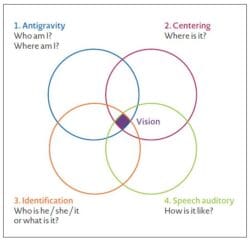
Circle 1: The Anti-Gravity Circle (The Foundation)
What It Is: This circle represents your child’s ability to maintain upright posture and fight against gravity. It’s about postural control, balance, and core strength.
Why It Matters: Before a child can focus on learning, their body must be able to stay upright against gravity. A baby who can’t hold their head up can’t look around and explore. A child who can’t sit upright can’t focus on reading or writing.
How Retained Reflexes Affect It:
Reflexes like the TLR (Tonic Labyrinthine) and STNR (Symmetrical Tonic Neck) are crucial for developing anti-gravity control. When these reflexes remain active, children struggle to maintain a stable posture.
Signs of Anti-Gravity Circle Disruption:
- Poor posture or slouching
- Difficulty sitting upright for extended periods
- Frequent position changes
- Fatigue from maintaining posture
- Clumsiness or balance problems
- Difficulty with stairs or uneven surfaces
Circle 2: The Centering Circle – Where is it? (Balance and Coordination)
What It Is: This circle represents your child’s ability to coordinate both sides of their body and cross the midline (the imaginary line down the centre of the body). It’s about bilateral coordination and midline crossing.
Why It Matters: Midline crossing is essential for reading (eyes moving left to right across the page), writing (hand crossing the midline), and coordinated movement (one side of the body working with the other). Without proper centring, children struggle with these fundamental skills.
How Retained Reflexes Affect It:
Reflexes like the ATNR (Asymmetrical Tonic Neck) are crucial for developing midline crossing and bilateral coordination. When this reflex remains active, children have difficulty coordinating both sides of their body.
Signs of Centering Circle Disruption:
- Difficulty crossing the midline (reaching across the body)
- Poor bilateral coordination (using both sides together)
- Difficulty with eye tracking across a page
- Uneven hand dominance or confusion about which hand to use
- Difficulty with activities requiring both sides to work together
- Reading difficulties (skipping words, losing place)
Circle 3: Identification Circle – What is it? (Eye Movement and Attention)
What It Is: This circle represents your child’s ability to move their eyes smoothly and accurately, focus on objects, and maintain attention. It’s about eye tracking, saccades (quick eye movements), and sustained focus.
Why It Matters: Reading requires smooth eye movements across the page. Learning requires the ability to focus on the teacher, the board, and written materials. Without proper focus and directional control, children struggle academically.
How Retained Reflexes and Irlen Syndrome Affect It:
Retained reflexes disrupt the postural and coordination foundation that eye tracking depends on. Irlen Syndrome directly affects visual processing and causes visual discomfort that makes focusing difficult.
Signs of Focus/Directional Circle Disruption:
- Difficulty tracking across a page while reading
- Skipping words or lines
- Losing place while reading
- Difficulty following the teacher’s movements or pointing
- Poor eye contact
- Difficulty sustaining attention
- Appears to “zone out” or daydream
- Difficulty copying from the board
Circle 4: Speech / Language (naming) – Auditory Processing
What It Is: This is the ability to process what is seen and communicate about it to the outside world. Permits and provides analysis and communications skills.
Why It Matters: This allows us to talk about what we observe and share ideas and insights with others.
How Retained Reflexes and Irlen Syndrome Affect It:
The retained reflex disrupts the individual’s ability to recognise and label objects. This interferes with spelling and processing skills – Irlen Syndrome directly affects the recognition of objects.
Signs of Speech / Language Disruption:
- Poor letter / shape recognition
- Difficulty naming letters / objects
- Unable to process multiple instructions
- Language delay
- Auditory Processing difficulties
The Cascade Effect
When the bottom circles (Anti-Gravity and Centering) are disrupted by retained reflexes, the effects cascade upward through the Focus/Directional and Binocular Vision circles. The result is a child who struggles academically and developmentally, even though the root cause is a foundational issue.
Example:
A child with a retained STNR reflex can’t maintain stable posture (Anti-Gravity Circle disrupted). Because posture is unstable, eye tracking is disrupted (Focus/Directional Circle affected). Because eye tracking is disrupted, reading becomes difficult. Because reading is difficult, academic performance suffers. Because academic performance suffers, the child becomes anxious and discouraged.
The child appears to have a reading problem, but the real issue is a retained reflex affecting the foundation.
Irlen Syndrome: A Different Type of Visual Processing Problem
While retained primitive reflexes disrupt visual development through postural and coordination problems, visual processing difficulties can also stem from another source: Irlen Syndrome.
What Is Irlen Syndrome?
Irlen Syndrome (also called Scotopic Sensitivity Syndrome) is a light-based visual processing problem. The brain overreacts to light and visual stimuli, creating a variety of visual, physical, cognitive, and emotional symptoms.
Important: Irlen Syndrome is NOT a vision problem. People with Irlen Syndrome can have perfect 20/20 eyesight. It’s a perceptual processing problem—how the brain processes visual information, not how the eyes see.
How Irlen Syndrome Differs from Dyslexia
Many parents confuse Irlen Syndrome with dyslexia because both can cause reading difficulties. But they’re fundamentally different:
Irlen Syndrome is a perceptual/visual processing disorder. The brain overreacts to light and visual stimuli, causing visual discomfort, distortions, and difficulty processing visual information. It affects all visual processing (reading, depth perception, sports, driving).
Dyslexia is a language-based learning disability. The brain has difficulty connecting letters with sounds and processing language. It primarily affects language skills (reading, spelling, writing).
The Key Difference: A child with dyslexia struggles with phonics. A child with Irlen Syndrome sees distortions on the page.
Can They Co-Occur?
Yes! A person can have dyslexia AND Irlen Syndrome at the same time. A child can also have retained reflexes AND Irlen Syndrome. This is why comprehensive assessment is so critical: identifying all contributing factors determines the appropriate intervention.
Signs of Irlen Syndrome
- Light Sensitivity
- Bothered by bright lights, fluorescent lights, sunlight, or glare
- Prefers dim lighting for reading
- Complains that lights hurt their eyes
- Becomes tired, sleepy, dizzy, or anxious in bright environments
- Gets headaches or migraines in bright or fluorescent lighting
- Squints frequently or shields eyes from light
- Irritable or restless in brightly lit spaces
Reading Problems
- Slow or inefficient reading
- Poor reading comprehension
- Misreads words or sees words incorrectly
- Difficulty tracking from line to line
- Frequently skips words or lines
- Loses place while reading
- Takes frequent breaks while reading
- Avoids reading activities
- Words appear blurry, moving, or disappearing
Visual Discomfort and Distortions
- Eye strain or fatigue
- Eyes hurt or become watery
- Sees visual distortions on the page (words appear to shimmer, move, or blur)
- Print looks different or unstable
- Environment looks different or distorted
- Attention and Concentration
- Difficulty concentrating when reading
- Appears to have attention problems (may be misdiagnosed as ADHD)
- Can’t sustain focus on visual tasks
- Performance deteriorates with extended reading
Writing Problems
- Trouble copying from the board
- Unequal spacing between words or letters
- Unequal letter size
- Writing uphill or downhill
- Inconsistent spelling
- Depth Perception Issues
- Clumsiness or appears accident-prone
- Difficulty catching balls
- Difficulty judging distances
- Extra caution necessary whilst driving (for older children)
- Avoids activities requiring depth perception
Academic and Behavioural Signs
- Difficulty with maths computation
- Sloppy, careless errors
- Misaligned numbers in columns
- Difficulty reading music
- Lack of motivation
- Grades do not reflect effort
- Fatigue or tiredness from schoolwork
- Strain from computer use
- The Solution for Irlen Syndrome
Irlen Syndrome is highly treatable with coloured overlays or spectacle filters. Many children experience dramatic improvements in reading speed, comprehension, and comfort when they find their optimal colour. A behavioural optometrist trained in Irlen assessment can identify whether light sensitivity is affecting your child’s reading and learning.
Additionally, lighting adjustments and environmental modifications (reducing fluorescent lighting, increasing natural light, adjusting screen brightness) can significantly improve visual comfort and academic performance.
The Connection: How Retained Reflexes and Irlen Syndrome Both Affect Skeffington’s Circles
Both retained reflexes and Irlen Syndrome can disrupt your child’s visual development and learning, but they do so through different mechanisms:
Retained Reflexes disrupt the Anti-Gravity and Centering Circles through postural instability and coordination problems. This foundational disruption cascades upward, affecting the Focus/Directional and Speech / Language circles.
Irlen Syndrome directly affects the Focus/Directional Circles through light sensitivity and visual processing difficulties. It doesn’t disrupt posture or coordination but directly impacts visual comfort and processing.
The Important Point: A child can have retained reflexes, Irlen Syndrome, or both. This is why comprehensive assessment that evaluates all four circles is essential.
Recognising the Signs: When to Seek Professional Help
General Signs of Retained Primitive Reflexes
- Difficulty sitting still or maintaining stable posture
- Poor coordination, balance, or spatial awareness
- Clumsiness or frequent stumbling
- Difficulty with fine motor skills (writing, drawing, buttoning)
- Poor eye tracking or difficulty following moving objects
- Anxiety, sensory sensitivity, or emotional dysregulation
- Difficulty focusing or sustaining attention
- Avoidance of physical activities or sports
- Fidgeting or restlessness, especially during reading or schoolwork
- Difficulty copying from the board or taking notes
- Reading or writing struggles despite clear eyesight
When to Seek Assessment
Consider a professional assessment if your child shows:
- Multiple signs of retained primitive reflexes that persist beyond expected developmental ages
- Reading or learning difficulties that don’t improve with standard interventions
- Light sensitivity or visual distortions while reading
- A combination of coordination, balance, and visual processing difficulties
- Anxiety or emotional dysregulation that seems connected to sensory input
- Signs that suggest both retained reflexes AND Irlen Syndrome
Who Can Help?
Behavioural Optometrist: Specialises in vision development and visual processing; can assess both reflex-related and Irlen-related visual difficulties
Occupational Therapist: Can assess and treat retained reflexes and developmental delays
Irlen Specialist: Trained to identify and treat Irlen Syndrome with colour filter testing
Developmental Specialist: Can evaluate overall developmental progress and identify areas of concern
Institute for Neuro-Physiological Psychology (INPP) practitioner: Trained to treat neuro-motor immaturity, including retained reflexes
The Power of Early Intervention
Research shows that early identification and intervention can significantly improve outcomes. When children’s retained reflexes are integrated or whose Irlen Syndrome is identified, they often experience dramatic improvements in:
- Academic Performance: Reading speed and comprehension improve dramatically
- Coordination and Balance: Physical skills develop more normally
- Confidence and Self-Esteem: Children feel more capable and successful
- Emotional Well-Being: Anxiety decreases, emotional regulation improves
- Concentration and Focus: Ability to sustain attention increases
- Social Relationships: Improved coordination and confidence lead to better peer relationships
Why Early Intervention Matters
The younger a child is when intervention begins, the faster and more complete the improvement typically is. This is because the brain is most plastic (able to change and adapt) during early childhood. However, it’s never too late to start- children and even adults can benefit from appropriate treatment.
What Treatment Looks Like
Assessment
Professional assessment for retained reflexes and visual processing difficulties is designed to be non-invasive, child-friendly, and informative. It typically includes:
Observation and History: Assessment of posture, movement, and coordination, along with developmental history
Movement Testing: Specific movements and positions to assess balance, coordination, and postural control
Reflex Checks: Specialised testing to identify which primitive reflexes remain active
Visual Processing Evaluation: Assessment of eye tracking, visual field awareness, and light sensitivity
Colour Filter Testing: For Irlen Syndrome identification (if appropriate)
Treatment Options
For Retained Reflexes:
Reflex Integration Therapy: Specialised exercises and movements designed to integrate retained reflexes
Vision Therapy: Structured activities that develop visual skills and improve how the eyes and brain work together
Occupational Therapy: Develops motor skills, sensory processing, and daily living skills
Multisensory Approaches: Integrates movement, vision, hearing, and touch for comprehensive development
For Irlen Syndrome:
Coloured Filters and Overlays: Customised coloured overlays or spectacle filters reduce light sensitivity and improve reading
Lighting and Environmental Adjustments: Reducing fluorescent lighting, increasing natural light, and adjusting screen brightness
A Message to Parents
If you recognise signs of retained primitive reflexes or Irlen Syndrome in your child, know that help is available. You are not alone in noticing that something seems off. Trust your instincts and seek professional guidance.
Many parents describe the moment they discovered their child’s retained reflexes or Irlen Syndrome as a turning point. Suddenly, their child’s struggles made sense. The behaviours that seemed like laziness or defiance were actually symptoms of a neurological condition. And most importantly, once they understood the root cause, they could provide the right support.
You don’t have to figure this out alone. At Christopher Young Opticians, we specialise in comprehensive developmental and visual processing assessment. We understand that vision is about much more than 20/20 eyesight. We’re here to help you understand your child’s development, identify root causes, and create a plan for success.
Next Steps
If you recognise signs of retained primitive reflexes or Irlen Syndrome in your child:
1. Observe: Watch for the signs listed in this article
2. Document: Note specific examples of behaviours or difficulties you notice
3. Trust Your Instincts: If something seems off, seek professional guidance
4. Get Assessed: Contact a behavioural optometrist, occupational therapist, or developmental specialist
5. Develop a Plan: Work with professionals to create an intervention plan tailored to your child’s needs
6. Be Patient: Reflex integration and visual processing improvements take time, but the results are worth it
About Christopher Young Opticians
At Christopher Young Opticians, we believe that every child deserves the opportunity to build strong foundations for a bright future. Our approach to behavioural optometry goes beyond traditional eye exams to assess how your child’s entire visual system supports learning, coordination, and development.
We specialise in:
Comprehensive developmental and visual processing assessment
Primitive reflex identification and intervention
Irlen Syndrome assessment and colour filter solutions
Vision therapy and visual development support
Behavioural optometry for children
If you have questions about your child’s development or would like to schedule a comprehensive assessment, we’d love to hear from you. Contact Christopher Young Opticians today.
Key Takeaways
1. Primitive reflexes are essential building blocks of development, not evolutionary remnants. When properly integrated, they create the neurological foundation for all learning, coordination, and emotional well-being.
2. Retained reflexes disrupt the foundation, directly affecting the Anti-Gravity and Centering Circles of Skeffington’s model. This foundational disruption cascades through all other systems, affecting learning, coordination, and emotional regulation.
3. Irlen Syndrome is a light-based visual processing problem, not a vision problem or dyslexia. It affects how the brain processes visual information and can cause reading difficulties, light sensitivity, and visual distortions.
4. Both retained reflexes and Irlen Syndrome are treatable. Early identification and intervention can significantly improve outcomes across multiple domains of development.
5. Professional assessment is the crucial first step. A comprehensive evaluation can identify which reflexes are interfering with development and which visual processing issues are present, guiding appropriate intervention.
6. Early intervention creates lasting change. The younger a child is when intervention begins, the faster and more complete the improvement typically is.
7. Understanding the root cause changes everything. When you shift from “What is wrong with this child?” to “What is this child’s nervous system trying to tell us?”, you open the door to compassionate, effective intervention that addresses root causes rather than just managing symptoms.
Resources and Further Reading
For more information about primitive reflexes, Irlen Syndrome, and child development, consider exploring:
– Behavioural optometry resources and research
– Primitive reflex integration therapy information
– Irlen Syndrome assessment and treatment options
– Skeffington’s Circles and vision development
– Child development and neurodevelopmental assessment
Have questions? Contact Christopher Young Opticians to discuss your child’s development and schedule a comprehensive assessment.
This blog post is for informational purposes and is not a substitute for professional medical or educational advice. If you have concerns about your child’s development, please consult with qualified healthcare or educational professionals.


